Broward County FL is a coastal county located in southeastern Florida between Miami-Dade and Palm Beach counties. Broward County FL, USA is known as a major administrative and population center that supports government services, business activity, and residential communities across South Florida. The county includes Fort Lauderdale and several surrounding cities that contribute to its economic and cultural activity. As a county overview in Florida, it plays a key role in transportation, tourism flow, and regional development, supported by major infrastructure such as Port Everglades and Fort Lauderdale-Hollywood International Airport. These systems connect local movement with national and international routes, making the county a key hub in the state.
Broward County FL USA has a population of over 1.9 million residents and continues to grow due to strong employment sectors and coastal living appeal. The area combines urban centers, suburban neighborhoods, and beachfront communities, creating a balanced living environment. The local economy is supported by tourism, healthcare, education, logistics, and marine trade. Broward County FL also features a diverse population that contributes to cultural variety across food, festivals, and daily life. Roads, rail connections, and airport access support steady movement throughout the region, linking business districts with residential zones. This combination of population density, economic activity, and coastal geography positions Broward County FL as one of the most active counties in Florida.
Where is Broward County Located?
Broward County sits in the southeastern part of Florida within the South Florida region. It lies between Miami-Dade County and Palm Beach County along the Atlantic coastline. When asking where Broward County is in FL, it is found along the state’s southeast coast, forming part of the major Miami metropolitan area.
Exact Location in Florida
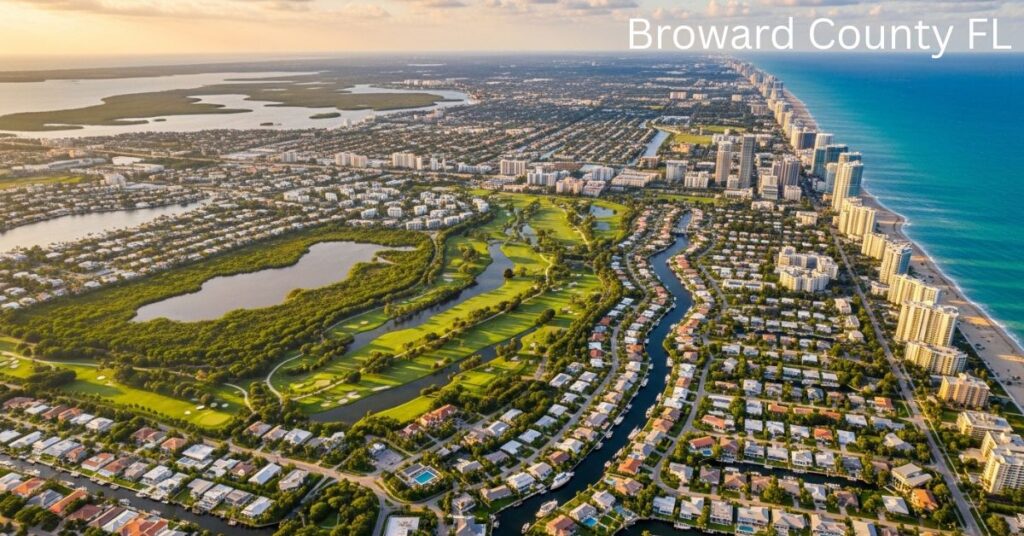
Broward County is positioned in the lower portion of Florida’s peninsula. It spans both inland areas and the Atlantic shoreline, creating a mix of urban centers and coastal zones. The county extends from the Everglades in the west to the Atlantic Ocean in the east. This geographic span creates clear geographic boundaries between wetlands, residential zones, and coastal cities.
Location facts include:
- Located in Southeast Florida
- Part of the wider South Florida region
- Covers both the inland Everglades edge and the oceanfront areas
- Includes cities such as Fort Lauderdale, Hollywood, and Coral Springs
A location map of Florida shows Broward County placed just north of Miami-Dade County, forming a continuous urban corridor along the coast.
Simple Search for Broward County, FL Public Records
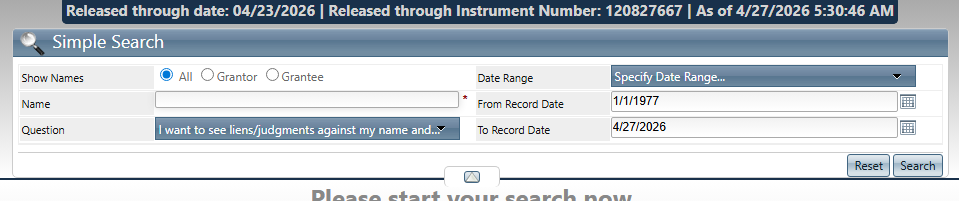
Broward County, FL, USA public records can be searched using the official Simple Search tool. This tool allows users to find names, property records, and official documents using flexible search filters.
- https://officialrecords.broward.org/AcclaimWeb/search/SearchTypeSimpleSearch
How to Use Broward County, FL, Simple Search
The Simple Search tool is designed for quick record lookup using basic details like name, date range, or document type.
Users can follow these steps:
Select Name Type
Choose how the search should be filtered:
- All
- Grantor
- Grantee
This helps narrow down Broward County, FL public records results.
Enter the Name
Type the person or business name in the search field.
This is commonly used for:
- Property ownership checks
- Legal record searches
- Civil document lookup
Set Date Range
Users can define a time period:
- From Record Date
- To Record Date
This helps filter Broward County, FL, USA records by timeline.
Add Search Question
A custom query box allows users to refine intent, such as:
- liens against a name
- judgments or filings
- recorded documents history
Click Search
After filling in the details, click Search to view official county records.
Neighboring Counties and Coastal Positioning
Broward County shares borders with several important Florida counties. These borders shape travel routes, economic zones, and regional planning.
Nearby counties:
- Miami-Dade County (south)
- Palm Beach County (north)
- Collier County (west, across the Everglades region)
Its eastern side faces the Atlantic Ocean, giving it a strong coastal positioning. Beaches like Fort Lauderdale Beach and Hollywood Beach sit directly along this shoreline.
Regional placement table:
| Direction | Area |
|---|---|
| North | Palm Beach County |
| South | Miami-Dade County |
| West | Everglades wetlands / Collier region |
| East | Atlantic Ocean |
This location places Broward County within a high-density coastal corridor. Major highways and waterways connect it to nearby metropolitan centers, supporting strong regional movement and trade activity.
Broward County, FL, Cities and Municipalities
Broward County, FL, includes a wide mix of cities and municipalities spread across coastal and inland zones. These areas form a dense network of urban communities with shared infrastructure and services. Each municipality in Broward County, FL, has its own local administration, zoning rules, and community services, shaping how residents experience daily life.
Major Cities and Municipalities Across Broward County, FL
Broward County, FL, contains several well-known cities that function as independent municipalities. These areas vary in size, population, and economic activity, yet they remain closely connected through transport and commerce.
Some of the most recognized cities include:
- Fort Lauderdale
- Hollywood
- Pembroke Pines
- Coral Springs
- Miramar
- Pompano Beach
- Sunrise
- Plantation
- Davie
- Deerfield Beach
- Weston
- Hallandale Beach
- Lauderhill
- Tamarac
These municipalities form a continuous urban network. Residential zones, business districts, and commercial corridors often extend across city borders. As a result, daily travel between cities is common for work, education, and services.
| City | Known For |
|---|---|
| Fort Lauderdale | Government center and coastal business activity |
| Pembroke Pines | Large residential population |
| Coral Springs | Planned suburban development |
| Hollywood | Beachfront tourism and entertainment |
| Miramar | Corporate offices and housing communities |
Fort Lauderdale as the Core Urban Center
Fort Lauderdale sits at the center of Broward County, FL’s municipal structure. It functions as the county seat and holds many administrative offices. This city also serves as a primary hub for transportation, commerce, and coastal activity. The city connects major highways, port facilities, and rail systems. This makes it a key transfer point within South Florida’s broader network of cities.
Fort Lauderdale also supports:
- Government operations for Broward County, FL
- Financial and legal districts
- Cruise and marine industries
- Tourism-driven businesses along the coastline
Its downtown district includes office towers, residential high-rises, and mixed-use developments. The surrounding coastal areas extend their influence across nearby municipalities.
City Distribution and Urban Pattern in Broward County, FL
Municipalities in Broward County, FL, are spread in a structured grid between the Atlantic coastline and inland areas. Coastal cities like Hollywood, Fort Lauderdale, and Pompano Beach feature higher density and tourism-related activity. In contrast, western cities such as Weston and Davie show more residential space, schools, and open land use. This creates a clear east-to-west variation in development.
Distribution traits include:
- Coastal strip: Higher population density and tourism zones
- Central corridor: Mixed residential and business districts
- Western areas: Suburban housing and education hubs
This arrangement supports steady movement between cities through major highways like I-95, Florida’s Turnpike, and I-595. Public transit and road systems connect municipalities into a single working network across Broward County, FL.
Geographic Features & Layout
Broward County, FL, sits along the southeastern coast of Florida with a flat, low-lying terrain shaped by water and coastal land. Its geographic layout reflects a coastal county where land and water share proximity across urban and natural zones. The area shows a mix of inland development and Atlantic shoreline influence. This balance defines how communities, roads, and natural spaces are arranged.
Coastal Position and Physical Setting
Broward County, FL, stretches along the Atlantic Ocean, forming a major part of Florida’s southeast coastline. The county sits between Miami-Dade County and Palm Beach County, creating a continuous coastal corridor. Its physical setting is mostly flat, with very little elevation change. This flat structure supports urban growth, wetlands, and canal systems.
Physical features include:
- Long Atlantic shoreline with sandy beaches
- Extensive canal networks for drainage and water control
- Urban zones close to coastal edges
- Inland areas with preserved wetlands and green spaces
The coastal county structure shapes transportation routes and residential development patterns. Cities often grow in linear patterns from west to east, moving from inland areas toward the ocean.
Climate Conditions in Broward County, FL
The county has a tropical climate influenced by ocean proximity. Warm temperatures remain common across most months, and humidity levels stay high due to surrounding water bodies. Rainfall patterns follow seasonal shifts, with heavier rain during summer months. Storm activity also increases during hurricane season, which affects coastal planning and infrastructure.
Main climate traits include:
- Warm and humid conditions for most of the year
- Distinct wet and dry seasonal changes
- Frequent afternoon thunderstorms in summer
- Ocean breezes that moderate inland heat
These climate factors affect daily life, building design, and transportation planning. Roads and drainage systems often reflect the need to manage heavy rainfall and water flow.
Land and Water Distribution
Broward County, FL, shows a strong mix of land and water areas. A large portion of the county includes canals, wetlands, and water management zones alongside developed land. The land distribution is shaped by both natural features and human planning. Urban regions dominate central and eastern sections, while conservation areas remain in western zones.
A simple breakdown of the area pattern:
| Area Type | Description |
|---|---|
| Urban land | Residential, commercial, and infrastructure zones |
| Wetlands | Natural marshes and protected ecosystems |
| Water systems | Canals, lakes, and drainage channels |
| Coastal zones | Beaches and ocean-facing areas |
Water plays a major role in shaping settlement patterns. Canals help manage flood risks, while wetlands support biodiversity and environmental balance.
Broward County, FL Population & Demographics
The population of Broward County, FL, is close to 1.9 million residents, according to recent census estimates. Broward County, Florida
This places it among the most populous counties in Florida, with steady growth driven by migration, housing development, and job opportunities in major cities such as Fort Lauderdale and Hollywood.
Population Size and Census Data
Census data shows Broward County consistently ranks near the top in Florida for total population. The 2020 census recorded about 1.94 million people, and current estimates suggest slow but steady increases each year. Most residents live in urban centers such as Fort Lauderdale, Pembroke Pines, and Coral Springs. These cities contain dense housing areas, apartment communities, and strong transportation links. As a result, population density remains much higher in eastern coastal zones compared to western regions. Western Broward County has more space for planned residential growth, which balances the overall distribution of people across the county.
Population Size and Census Data
The latest census data shows Broward County ranks among the most populated counties in Florida. The population sits near 1.94 million residents, based on 2020 U.S. Census figures, with ongoing estimates showing gradual increases. Urban areas such as Fort Lauderdale, Hollywood, and Pembroke Pines hold a major share of residents. These cities form dense residential clusters supported by housing, jobs, and transport networks.
Population facts:
- Total population: ~1.9–2.0 million
- Large urban concentration in coastal cities
- Suburban zones spread across western regions
- High household occupancy in apartment communities
The county shows strong population density in eastern coastal areas, while western zones remain less crowded with more open land and planned neighborhoods.
Diversity and Demographic Profile
Broward County reflects one of the most diverse populations in Florida. Residents come from a wide range of cultural, ethnic, and linguistic backgrounds, which shapes schools, businesses, and community life.
Main demographic patterns include:
- Significant Hispanic and Latino population share
- Large African American communities
- Growing Caribbean and South American immigrant groups
- The non-Hispanic White population is present across suburban zones
- Multilingual communities, with Spanish widely spoken
This mix of cultures influences housing demand, education systems, and local commerce. Many neighborhoods reflect international migration trends, especially from Latin America and the Caribbean.
Age distribution also remains balanced:
| Age Group | Share |
|---|---|
| Under 18 | Moderate share |
| 18–64 | Largest working-age group |
| 65+ | Strong retiree presence |
The presence of both working professionals and retirees creates a balanced demographic structure across the county.
Growth Trends and Population Density
Population growth in Broward County has remained steady over recent decades, driven by job opportunities, climate appeal, and relocation from other states and countries. New housing developments continue to appear in both urban and suburban areas. Population density is highest in coastal cities like Fort Lauderdale, where residential buildings and commercial zones are closely packed. Inland areas show lower density, with more planned communities and available land for future expansion. Economic sectors such as healthcare, tourism, and services continue to attract new residents, supporting gradual population growth and shaping long-term settlement patterns across the county.
Government & Civic Structure in Broward County, FL
Broward County, FL, operates through a centralized county government system that manages public services, law enforcement, and local infrastructure. The civic structure connects elected officials, departments, and administrative offices to serve residents across cities within the county.
How County Government Works in Broward County FL
Broward County, FL, follows a commission-based county governance model. A group of elected commissioners sets policies and approves budgets. These decisions shape services like transportation, public safety, housing programs, and environmental control.
The county system works through a clear division of authority:
- County Commissioners set policy direction and vote on county matters
- The County Administrator manages daily operations and implements policies
- Elected Officials like the Sheriff, Property Appraiser, and Clerk manage independent offices
- Municipal Governments handle city-level services, working alongside county functions
County governance also supports unincorporated areas where local city governments do not operate. In those zones, county departments provide direct services such as road maintenance, zoning, and emergency response.
Departments in Broward County, FL Administration
The administrative system of Broward County, FL, includes multiple departments that handle daily public services. Each department focuses on a specific civic responsibility tied to public needs and infrastructure.
Departments include:
- Public Works Department – road maintenance, drainage systems, and infrastructure planning
- Parks and Recreation – manages public parks, community spaces, and recreational programs
- Transit Division (BCT) – operates bus transportation across county routes
- Environmental Protection and Growth Management – handles zoning, land use, and environmental regulation
- Public Safety Services – coordinates emergency management and disaster response
- Health and Human Services – supports community health programs and social assistance
These departments operate under county-level oversight and coordinate with state agencies when needed. Budget allocation, staffing, and service priorities come from commission-approved plans.
Administrative Roles and Civic Structure
The civic structure in Broward County, FL, relies on defined administrative roles that separate policy, execution, and public accountability. Each role distinctly contributes to county operations.
Administrative positions include:
- County Administrator – oversees department performance and operational execution
- Assistant Administrators – manage specialized service areas like finance, infrastructure, or public safety
- Elected Constitutional Officers – handle independent functions such as law enforcement, records, and taxation
- Advisory Boards and Committees – review policies related to housing, environment, and community development
This structure creates a layered system of responsibility. Policy decisions come from elected commissioners, while administrative staff handles implementation across departments.
Economic & Regional Importance
Broward County, FL, holds a strong position in South Florida through active economic activity and steady urban development. The region supports a wide mix of industries that drive regional growth and job creation. Its economy connects tourism, trade, healthcare, aviation, and real estate in one continuous cycle of business movement.
Economy in Broward County, FL
Broward County, FL, runs on a diverse economic base that supports both local workers and international trade. The county has a population of over 1.9 million residents, which supports steady consumer demand and business activity. Economic sectors include healthcare systems, hospitality services, logistics, and marine trade. Fort Lauderdale and nearby cities act as commercial centers where employment opportunities stay consistent.
Major economic drivers include:
- Port Everglades supports global shipping and cargo flow
- Fort Lauderdale-Hollywood International Airport handles tourism and business travel
- Healthcare institutions serving a large population base
- Real estate development linked with population growth
- Retail and service industries support daily demand
Economic activity stays closely tied to population movement and tourism cycles. This balance supports a steady income flow across multiple sectors.
Business Environment and Urban Development
Business activity in Broward County, FL, benefits from strong infrastructure and continuous urban development. The county has become a preferred location for startups, corporate offices, and service-based firms. Commercial zones in Fort Lauderdale, Hollywood, and Coral Springs show steady expansion. Office spaces, mixed-use buildings, and retail centers reflect ongoing regional growth.
Business strengths:
| Sector | Activity Type | Economic Role |
|---|---|---|
| Technology | Startups, IT services | Job creation |
| Finance | Banking, investment firms | Capital flow |
| Healthcare | Hospitals, clinics | Workforce stability |
| Real Estate | Residential and commercial builds | Urban expansion |
Urban development supports both housing demand and business expansion. Road networks, port access, and airport connectivity improve the movement of goods and people across the region.
Infrastructure & Public Services
Broward County, FL, has a wide network of infrastructure that supports daily life through roads, transportation, schools, and public utilities. These public services help connect communities and support population growth across the county. The local systems focus on mobility, education access, and reliable utility services. This setup supports both residents and businesses across urban and suburban areas.
Roads & Transportation Systems in Broward County, FL
Broward County transportation systems support heavy daily movement across cities like Fort Lauderdale, Hollywood, and Coral Springs. Major highways such as I-95, I-75, and Florida’s Turnpike connect key areas and nearby counties. Public transportation is managed through bus routes and rail services that help reduce traffic pressure. The county also promotes shared transit options for short-distance travel.
Transportation features include:
- Broward County Transit (BCT) bus network across major routes
- Tri-Rail commuter rail connecting Miami, Fort Lauderdale, and West Palm Beach
- Fort Lauderdale-Hollywood International Airport for domestic and international travel
- Bike lanes and pedestrian pathways in selected urban zones
These systems improve commuting options and support local economic activity by linking residential and business zones.
Schools and Education Facilities
Education services in Broward County are managed through one of the largest public school systems in the United States. The system serves students across elementary, middle, and high school levels. The county also includes charter schools, magnet programs, and technical institutes that focus on career-based training. Higher education options include community colleges and universities within close reach.
Education points:
- Over 200 public schools serving diverse communities
- Magnet programs focused on science, arts, and technology
- Career and technical centers offering job-ready skills training
- Access to libraries and learning centers across cities
These educational services support student development and workforce preparation across different sectors.
Public Utilities and Local Systems
Public utilities in Broward County support daily household and business needs. These services include water supply, electricity, waste management, and emergency response systems. Local systems are managed by different agencies that handle maintenance and service distribution across cities and unincorporated areas.
Main utility services include:
- Clean water supply and wastewater treatment systems
- Electricity distribution managed by regional providers
- Waste collection and recycling programs
- Emergency services such as fire rescue and medical response
These services keep residential areas functional and support public health, safety, and infrastructure stability across Broward County.
FAQs About the Broward County FL
This section answers common questions about Broward County, FL, in a clear and direct format. It covers location, population, major cities, and the county’s role in South Florida.
Where is Broward County located?
Broward County sits in southeastern Florida along the Atlantic coastline. It is positioned between Miami-Dade County and Palm Beach County. The county forms part of the South Florida urban region with strong road and air connections. Major highways like I-95 and Florida’s Turnpike pass through the area. Its coastal position connects it to beaches, ports, and trade activity. This location supports both residential growth and business movement across the region.
What is the population of Broward County?
Broward County has nearly 1.95 million residents based on recent census estimates. It ranks among the most populated counties in Florida. The population continues to grow due to job availability and housing demand. Many residents come from diverse cultural backgrounds, including Latin American and Caribbean communities. Urban areas are highly dense, with steady expansion across suburban zones. This mix of growth and diversity shapes daily life across the county.
What cities are included in Broward County?
Broward County includes several major cities that form its residential and commercial structure. Fort Lauderdale serves as the county seat and a major tourism center. Other important cities include Hollywood, known for its beachfront areas, and Pembroke Pines, which has strong suburban development. Coral Springs and Miramar also contribute to growing residential zones and business activity. Together, these cities form a connected regional network.
Why is Broward County important?
Broward County plays a major role in South Florida’s economy and infrastructure. Its coastal access supports tourism, shipping, and international trade routes. The county has strong sectors in healthcare, aviation, and professional services. It also connects Miami and Palm Beach, making it a key transit and business corridor. Beaches, ports, and airports add to its economic strength. This combination supports long-term growth and regional importance.